Why Retail Mobility Needs Engineering, Not Guesswork
To choose the right castors for shopping carts Retail mobility has evolved far beyond simple carts and utility trolleys. Modern shopping malls now operate as complex ecosystems, combining retail, dining, entertainment, logistics, housekeeping, safety operations, and facility management within a single campus. Every day, goods, supplies, waste, equipment, and service tools are moved continuously across long corridors, food courts, service lifts, parking levels, and backend loading docks.
Behind the seamless customer experience lies a massive volume of internal movement. Shopping carts circulate constantly between aisles, food court trolleys shuttle meals and waste, housekeeping teams operate cleaning carts throughout the day, and maintenance teams move tools and equipment across multiple floors. This mobility is invisible to shoppers—but it is critical to mall operations.
At the core of this movement are castor wheels. Though often overlooked, castors directly influence noise levels, floor safety, hygiene standards, staff efficiency, maintenance frequency, and overall customer perception. A poorly selected wheel can create noise, cause floor damage, increase push effort, or fail prematurely—leading to operational disruption and higher long-term cost.
Choosing the right castor wheel for shopping carts, food court trolleys, and facility utility equipment is therefore not a procurement formality. It is an engineering and experience decision .
Why Retail Mobility Is Fundamentally Different from Industrial Mobility
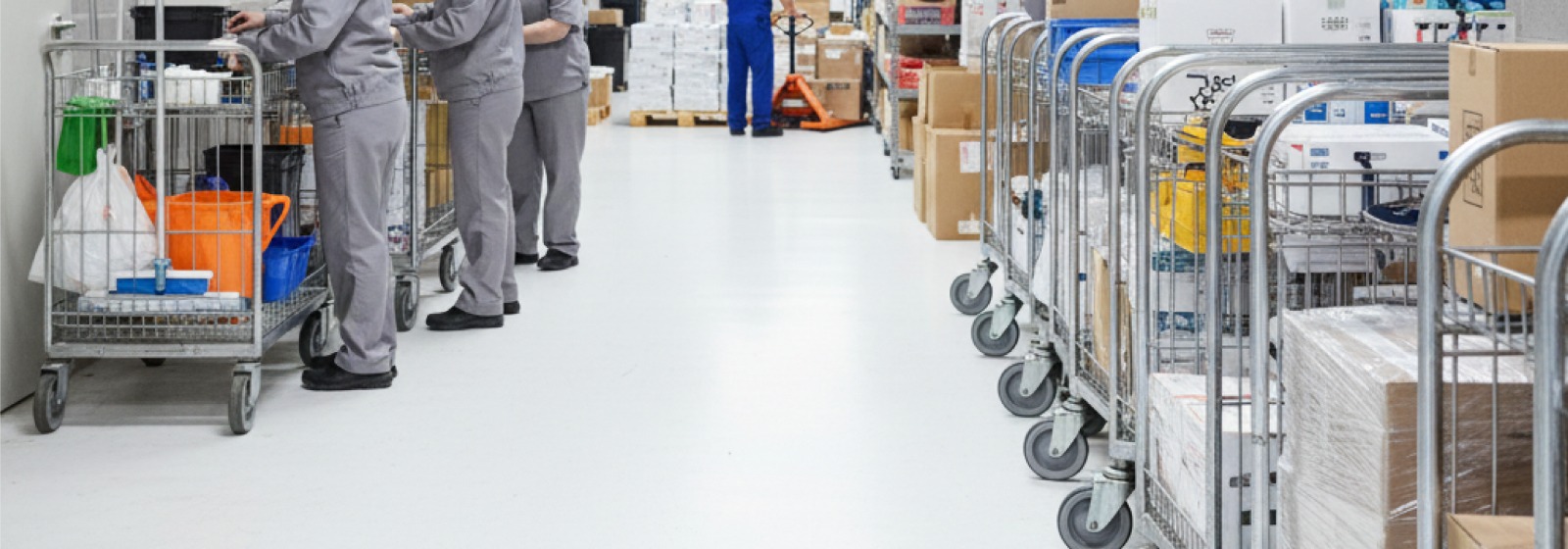
Castors used in industrial environments such as factories or warehouses are typically selected based on high load capacity and rugged durability. These environments tolerate noise, visible wear, and occasional maintenance interruptions. Retail environments, however, demand a completely different performance profile.
In a mall, castors must operate silently to preserve ambience. They must protect premium flooring such as marble, tiles, vinyl, or epoxy coatings. They must roll smoothly around customers, children, and elderly visitors without sudden jerks or directional instability. Hygiene becomes critical in food courts, where moisture, grease, and cleaning chemicals are present throughout the day.
Facility utility carts face their own challenges. They operate across basements, ramps, service corridors, elevators, and outdoor access points. They experience uneven floors, sudden level changes, and exposure to water and chemicals. Yet their operation must remain discreet, quiet, and safe.
Retail castors therefore need to deliver comfort, silence, hygiene, maneuverability, and longevity, not just strength. This is where engineered mobility solutions outperform generic catalogue wheels.
Choosing Castors for Shopping Carts: Customer Experience Starts at the Wheel
Shopping carts are the most visible mobility equipment in a retail environment. Customers interact with them directly, often for extended periods. Any discomfort—noise, resistance, vibration, or instability—is immediately noticed and subconsciously associated with the quality of the mall or store.
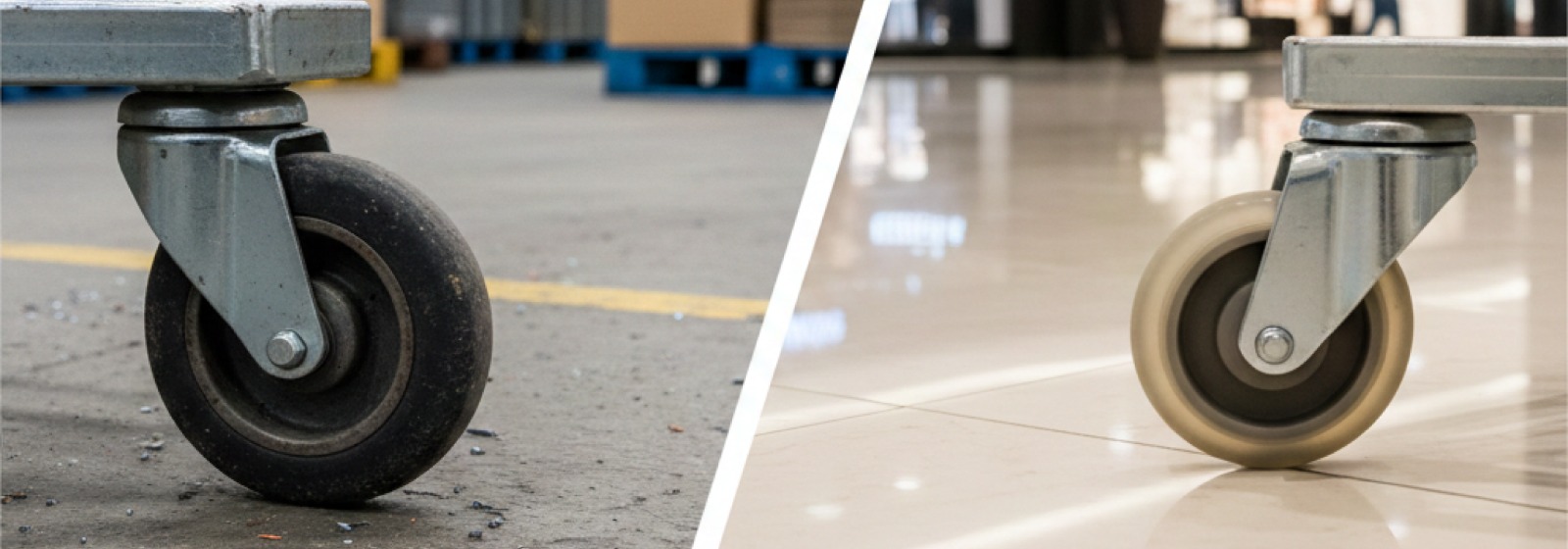
Silent rolling is therefore essential. High-quality shopping cart castors use precision ball bearings combined with polyurethane (PU) treads to ensure whisper-quiet movement across smooth floors. Low-grade wheels tend to rattle, squeak, or vibrate, especially as bearings wear unevenly over time.
Floor protection is equally critical. Mall flooring represents a significant investment, and incorrect wheel hardness can cause scratches, skid marks, or surface wear. PU wheels with optimized hardness strike the right balance between load-bearing capability and floor friendliness, ensuring smooth rolling without surface damage.
Maneuverability also plays a key role. Shopping carts must navigate narrow aisles, tight turns, escalator lobbies, and crowded spaces. Precision swivel geometry and deep raceway bearings ensure directional stability, preventing wobble or flutter during movement.
Finally, hygiene and durability cannot be ignored. Shopping carts are exposed to beverage spills, moisture from entrances, and frequent cleaning. Sealed bearings and corrosion-resistant components prevent rust, contamination, and premature failure.
Choosing Castors for Food Court Trolleys: Hygiene, Safety, and Service Efficiency
Food courts operate under constant pressure. Service trolleys move continuously between kitchens, counters, seating areas, and waste zones. They encounter moisture, grease, food residue, steam, and aggressive cleaning agents throughout the day.
Castors in this environment must be non-porous, sealed, and chemically resistant. Polyurethane and nylon wheels paired with stainless steel or corrosion-resistant brackets perform best, as they resist absorption and withstand repeated wash-downs without degradation.
Smooth rolling is not just about comfort—it is about safety. Food trolleys often carry hot items, liquids, or stacked trays. Any vibration or sudden jerk can cause spills, injuries, or service delays. A well-engineered tread with shock-absorbing properties ensures stable movement even over small floor transitions or gentle slopes.
Braking and parking stability are equally important. Food service trolleys must remain stationary when parked, especially in sloped or crowded areas. Precision braking systems allow easy foot operation while ensuring the trolley does not drift unintentionally.

Choosing Castors for Facility Utility Equipment: Reliability Behind the Scenes
Facility utility equipment includes housekeeping carts, janitorial trolleys, waste bins, HVAC service carts, security equipment, emergency response wagons, and parking-level utility carriers. These carts operate mostly out of sight but are essential to smooth mall functioning.
Unlike shopping carts, facility utility carts often carry dense and uneven loads, such as water tanks, cleaning machines, tools, or electrical equipment. The dynamic load during movement frequently exceeds static catalogue ratings, especially during acceleration, braking, or ramp transitions.
Castors for these applications require reinforced brackets, robust bearing systems, and structural rigidity to prevent deformation and premature wear. Corrosion resistance is crucial, as housekeeping carts are constantly exposed to water, disinfectants, and cleaning chemicals.
At the same time, these carts must remain discreet. Excessive noise, floor vibration, or visible wheel damage reflects poorly on facility management. Correct wheel hardness, sealed tread design, and continuous-duty bearings ensure long service life with minimal maintenance intervention.
The Hidden Cost of Wrong Castor Selection in Retail Environments
When inappropriate castors are used in retail settings, problems accumulate gradually but consistently. Operators experience increased push effort, wheels begin to wobble, noise levels rise, and floors show visible damage. Maintenance teams replace wheels more frequently, often during peak hours, leading to service interruptions.
Over time, the total lifecycle cost of low-quality castors can be five to nine times higher than that of engineered solutions. These costs are not always captured in procurement spreadsheets, but they appear in maintenance logs, customer complaints, and staff fatigue.
Engineered castors, while sometimes higher in initial cost, offer predictable performance, longer replacement cycles, and lower overall operational expense.
Recommended Wheel Materials for Retail and Mall Applications
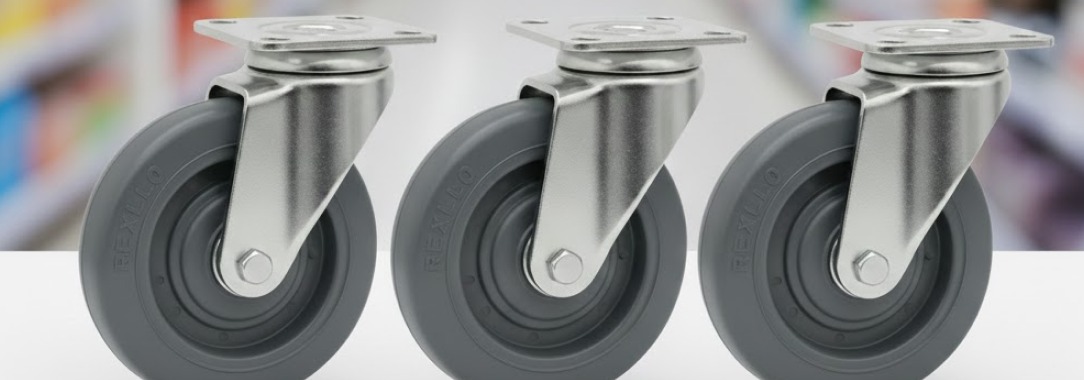
Material selection is one of the most critical aspects of castor performance. Polyurethane wheels are widely preferred in retail environments due to their silent rolling, floor safety, hygiene, and durability. They provide excellent rolling comfort while protecting premium flooring.
Nylon wheels are particularly suitable for chemically intensive or hygiene-sensitive zones such as food preparation, dishwashing, and housekeeping areas. Rubber wheels, while offering shock absorption, must be used selectively due to potential marking on polished floors. Stainless steel assemblies are essential in high-moisture or high-hygiene zones, providing corrosion resistance and wash-down compatibility.
Selecting the right combination of wheel material, bearing type, and bracket finish ensures optimal performance for each application.
Why Rexello Is Ideal for Retail and Mall Mobility
Rexello approaches retail mobility as an engineering challenge, not a catalogue exercise. Its castor solutions are designed with precision bearings, optimized tread hardness, sealed and corrosion-resistant assemblies, and consistent batch quality.
Rexello supports shopping carts, food court trolleys, facility utility equipment, janitorial carts, emergency units, and OEM mobility systems. By focusing on lifecycle performance rather than short-term cost, Rexello helps malls achieve quieter operation, safer movement, lower maintenance burden, and better customer experience.
Conclusion: Retail Mobility Is a Customer Experience Decision
Choosing castor wheels for shopping carts, food court trolleys, and facility utility equipment is not merely a technical decision. It directly affects customer comfort, mall aesthetics, hygiene standards, staff efficiency, and long-term operational cost.
Engineered castors deliver silent movement, stable handling, floor protection, corrosion resistance, and long service life. Cheap wheels, by contrast, create noise, damage floors, disrupt operations, and increase hidden costs.
In modern retail environments, mobility quality reflects brand quality. Investing in engineered castor solutions is an investment in experience, efficiency, and sustainability.
CTA – Rexello
Need engineered castor wheels for shopping carts, food court service, or facility utility equipment?
Rexello manufactures silent, hygienic, floor-safe and corrosion-resistant castors designed for long-duty retail operations.
📧 info@rexello.com | 📞 +91-79001 47477 | 🌐 www.rexello.com